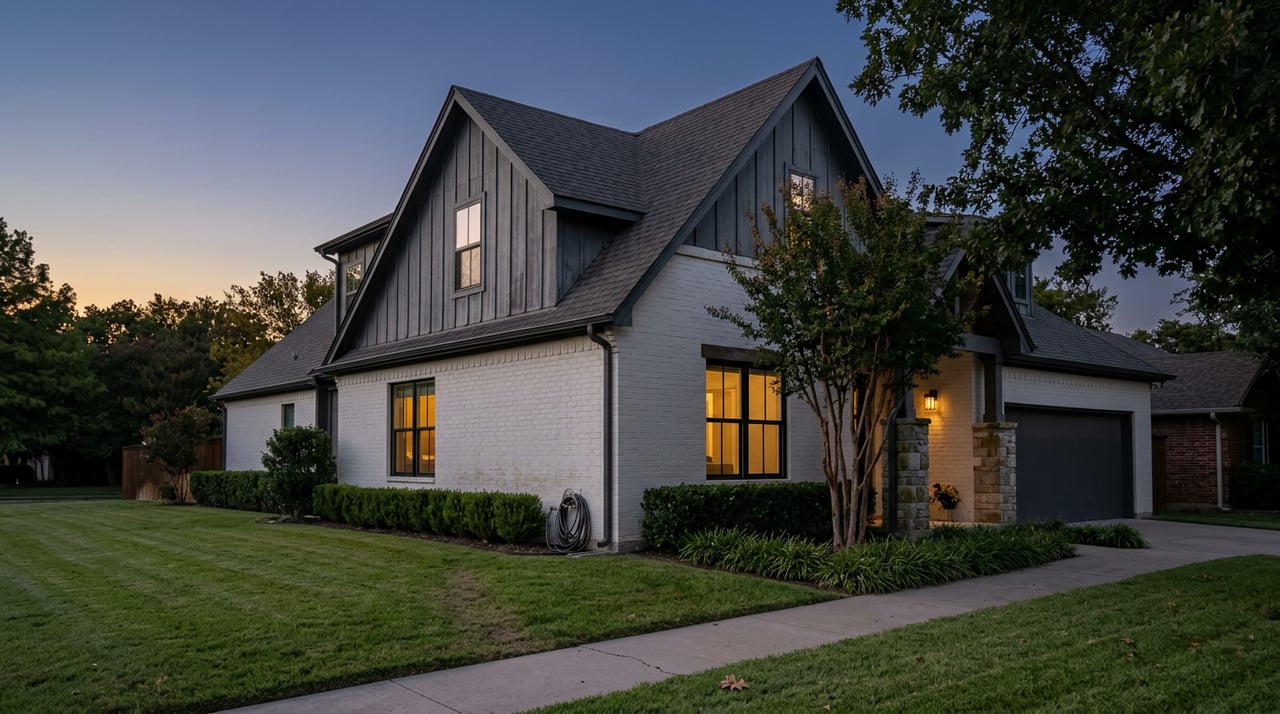
Bent Tree and Bent Tree West Share a Name. The Median Price Doesn't Agree With Itself.
August 27, 2026
August 27, 2026
Open three real estate data sites and search "Bent Tree" and you'll find three different stories about the same North Dallas neighborhood. In the 30 days ending in mid-April 2026, one site's tracked closings put the median sale price at $742,000, down 23.1 percent from a year earlier. Around the same time, a second site showed a median of $668,000 for the neighborhood, up 25.9 percent year over year. A third site's trailing 12-month figure, which averages a full year instead of a single month, landed at $514,900, up 6 percent. Three sites, three numbers, and a spread of more than $225,000 depending on which tab happened to be open.
None of these sites made an error. This is what happens when a neighborhood sells so few homes in a given month that the median stops behaving like a market indicator and starts behaving like a coin flip.
That's the real problem for anyone comparing Bent Tree to its close, similarly named neighbor Bent Tree West. The two places get treated as interchangeable because they share a name, sit within a few minutes of each other in Far North Dallas, and both show up when you search for either one. But they're governed by different homeowners associations, zoned to different school districts in places, and priced by data sets thin enough that a single high-end sale can swing the "median" by six figures overnight. If you're shopping this stretch of North Dallas by scanning listing-site medians, you're not comparing two neighborhoods. You're comparing two noise levels.
The name "Bent Tree" was never one HOA. The original master-planned community, built out mostly from the late 1970s through the 1990s and centered on Bent Tree Country Club and the neighboring Preston Trail Golf Club, actually contains several distinct sub-associations: Old Bent Tree, Bent Tree Village, Bent Tree Royal, Bent Tree North, and Bent Tree West. Each runs its own board, its own dues structure, and in some cases its own amenities. Bent Tree West split off as its own homeowners association entirely, with 688 custom homes and a governance structure separate from the country-club core.
The community also straddles a county line. The northern section of Bent Tree feeds into Plano ISD, while the southern section attends Dallas ISD schools. That split runs through the middle of a neighborhood that most listing descriptions treat as a single unit. A buyer comparing two Bent Tree addresses a mile apart could be comparing two different school districts and, depending on the exact parcel, two different counties for tax and appraisal purposes.
Bent Tree West avoids that ambiguity by not having it. According to its own homeowners association, Bent Tree West sits entirely within Plano ISD, with Mitchell Elementary within walking distance of every home in the neighborhood. It has its own park with a playground and a shaded picnic area, and its own private swim and tennis club, rather than optional membership access to the country club that anchors the original Bent Tree.
Sitting in the middle of the larger Bent Tree footprint is one more detail worth knowing if you're touring the area: the historic Frankford Church, with its windmill and small cemetery, surrounded by a creek and a prairie meadow. It's the kind of landmark that tells you this neighborhood predates the subdivisions built around it, and it's a useful way to distinguish "the Bent Tree with the old church in the middle" from "the Bent Tree West with its own swim club" when you're trying to keep the two straight on a map.
Here's where the comparison gets genuinely useful instead of just confusing.
In the 30 days ending mid-April 2026, one data platform tracked 7 closed sales in Bent Tree at a median of $742,000, a drop of 23.1 percent from the same period a year earlier. That same platform counted 11 new listings during the period and a median of 24 days on market, both signs of a neighborhood moving through very few transactions in any given month. Around that same time, a second platform's own tracked data put Bent Tree's median sale price at $668,000, up 25.9 percent year over year, a gap of nearly $75,000 for what both sites labeled as the same neighborhood in the same season.
Those aren't two views of a stable number. They're two different samples of a market so thin that a handful of sales can swing the result hard in either direction. A single high-end sale near the golf course can move a monthly median almost by itself. Homes backing directly onto Bent Tree Country Club's 15th fairway have listed for more than $7 million this year. If a sale at that scale closes in the same month as a run of $500,000 resales, the reported median swings hard in a direction that has nothing to do with the neighborhood's overall trajectory. These specific numbers are already a season old, but the mechanism behind them isn't seasonal. It shows up every month in a neighborhood this size, which is exactly why it's still worth understanding today.
Bent Tree West shows the same pattern at an even smaller scale. With only 688 homes total in the association, monthly sales counts run low enough that one tracked source put Bent Tree West's median sale price at $312,000 in March 2026, down 30.7 percent year over year. That kind of swing in a 688-home HOA doesn't signal a neighborhood in decline. It signals a sample size too small to support the headline it's generating.
Most North Dallas subdivisions sell enough homes in a typical month that medians settle into something reasonably stable. Bent Tree and Bent Tree West don't have that luxury, and for a specific reason: they're both mature, built-out communities with limited new construction and lot sizes ranging from a fifth of an acre up to a full acre or more. There's no steady drip of new inventory keeping monthly sales counts high. What sells in a given month is whatever a handful of longtime owners decided to list, and that mix can shift from mostly estate-lot country-club homes one month to mostly standard resales the next.
That's a structural feature of an established, low-turnover neighborhood, not a flaw. But it means the headline number on a listing site tells you less here than it would in a newer subdivision with dozens of monthly closings. If you're comparing Bent Tree to Bent Tree West using nothing but the median price each site displays, you're comparing two numbers built on some of the thinnest sales data in North Dallas.
If you're weighing these two neighborhoods, or any two similarly named, adjacent communities in this market, the median price on a listing page is the last thing to trust and the first thing to question. A few better questions:
Are Bent Tree and Bent Tree West the same homeowners association? No. They're separate HOAs with their own boards and dues. Bent Tree West has its own private swim and tennis club and park, while the original Bent Tree centers on optional membership access to Bent Tree Country Club.
Does Bent Tree West have access to Bent Tree Country Club? Bent Tree West's own HOA describes its amenities as a park with a playground and picnic area, along with its own swim and tennis club, rather than country-club access. Any golf or country-club membership would be a separate arrangement, not an included neighborhood amenity.
Why do two real estate sites show different median prices for the same neighborhood? Because they're often measuring different time windows, a trailing 12 months versus the most recent 30 days, on a small number of monthly sales. In a neighborhood where only a handful of homes close each month, one high-end or low-end sale can shift the reported median by a wide margin without reflecting a real change in value.
If you're trying to compare Bent Tree, Bent Tree West, or any other North Dallas neighborhood past the number a portal shows you, that's exactly the kind of read a local agent should walk you through before you make an offer or price a listing. Kathy Beck and the Beck Residential Group work these North Dallas submarkets closely enough to know which comps actually apply to your address and which HOA governs it. Let's Connect.
Stay up to date on the latest real estate trends.
Kathy Beck takes a thoughtful, strategic approach to every client relationship, helping you navigate life's transitions with confidence. Whether you're downsizing, relocating, managing an inherited property, preparing for retirement, or embracing a lifestyle change, you'll receive personalized guidance, expert market insight, and a plan designed around your unique goals.
KATHY BECK
ADDRESS
Keller Williams Realty Dallas Preston Road
18333 Preston Rd, Suite 100
Dallas TX, 75252